Blog
Can you make a podcast clip go viral? What the platforms say actually helps
By Lev PerlmanUpdated 4 min read
No one can make a podcast clip go viral on purpose, and anyone who promises it is guessing. What you can do is make clips that do well on the things the platforms say they measure: whether people stop for it, watch it to the end, and share it. That comes down to a strong first line, a moment that works on its own, a tight edit, and captions.
This post sets out what TikTok, Instagram and YouTube publish about their recommendations, then turns it into a checklist.
What do the platforms say they look for?
TikTok
TikTok says its For You feed is shaped by how people interact with videos (likes, shares, comments, accounts followed), by information in the video such as captions, sounds and hashtags, and, with less weight, by device and account settings. It says whether someone finishes a longer video is a strong signal, and that follower count and past high-performing videos are not direct factors.1
Instagram Reels
Instagram says Reels are ranked mainly on your activity (what you have liked, saved, reshared and commented on), your history with the account, information about the reel itself, and the account's popularity. The predictions it weighs most include how likely you are to reshare a reel, watch it to the end and like it.2
YouTube Shorts
YouTube says it looks at whether viewers choose to watch a Short or swipe past it, and lists signals including the percentage of viewers who chose to view, average view duration, average percentage viewed, likes and survey responses.3
What that means for a podcast clip
The three descriptions share a pattern. Each platform is trying to predict whether a viewer will stop, stay to the end and act (share, save, like or comment). A clip earns each one differently.
- 01
Hook
The line that makes someone stop scrolling
- 02
Context
Just enough to follow the idea
- 03
The idea
One point, said well
- 04
Payoff
The answer, the joke or the turn
Earn the stop: the first line
- Open on the hook, even if the speaker said it halfway through the moment. "Are we all going to die because of AI?" stops more people than "So, one thing I wanted to ask you was…".
- Show a face, close. A person talking straight towards the camera is easier to stop for than a wide room.
- Caption from the first word, so the hook works with the sound off.
Earn the watch time: one idea, tightly cut
- One point per clip. If a moment makes two points, it is two clips.
- Cut the pauses and false starts. Dead air is where people swipe.
- Keep the right face on screen. The speaker most of the time, with short reaction shots of the listener to keep it feeling like a conversation.
- End on the payoff. When the point lands, stop. A clip that ends cleanly is more likely to be watched to the end, and replayed.
Earn the share: something worth passing on
People share what makes them look informed, funny or right. Clips that tend to be shared:
- answer a question many people have, clearly;
- say something surprising or contrary, with a reason;
- tell a short story with a turn at the end;
- contain a line someone would quote to a friend.
A checklist before you post
- Does it make sense to someone who has never heard of the podcast?
- Is the most interesting line in the first two seconds?
- Is it captioned from the first word, clear of the app's buttons?
- Have the pauses and filler been cut?
- Does it end on the payoff, with nothing after it?
- Is it in the right shape for the platform? (See aspect ratios and lengths.)
- Is the post text adding something, not repeating the caption?
- If it is an ad or includes a paid partnership, is it labelled? (See the UK rules for posting clips.)
Post, measure and learn
No checklist predicts which clip will take off. Post consistently, then look at each platform's analytics for the clips people watched to the end and shared, and make more like those. Your audience will teach you more than any rule.
Where podswitch fits
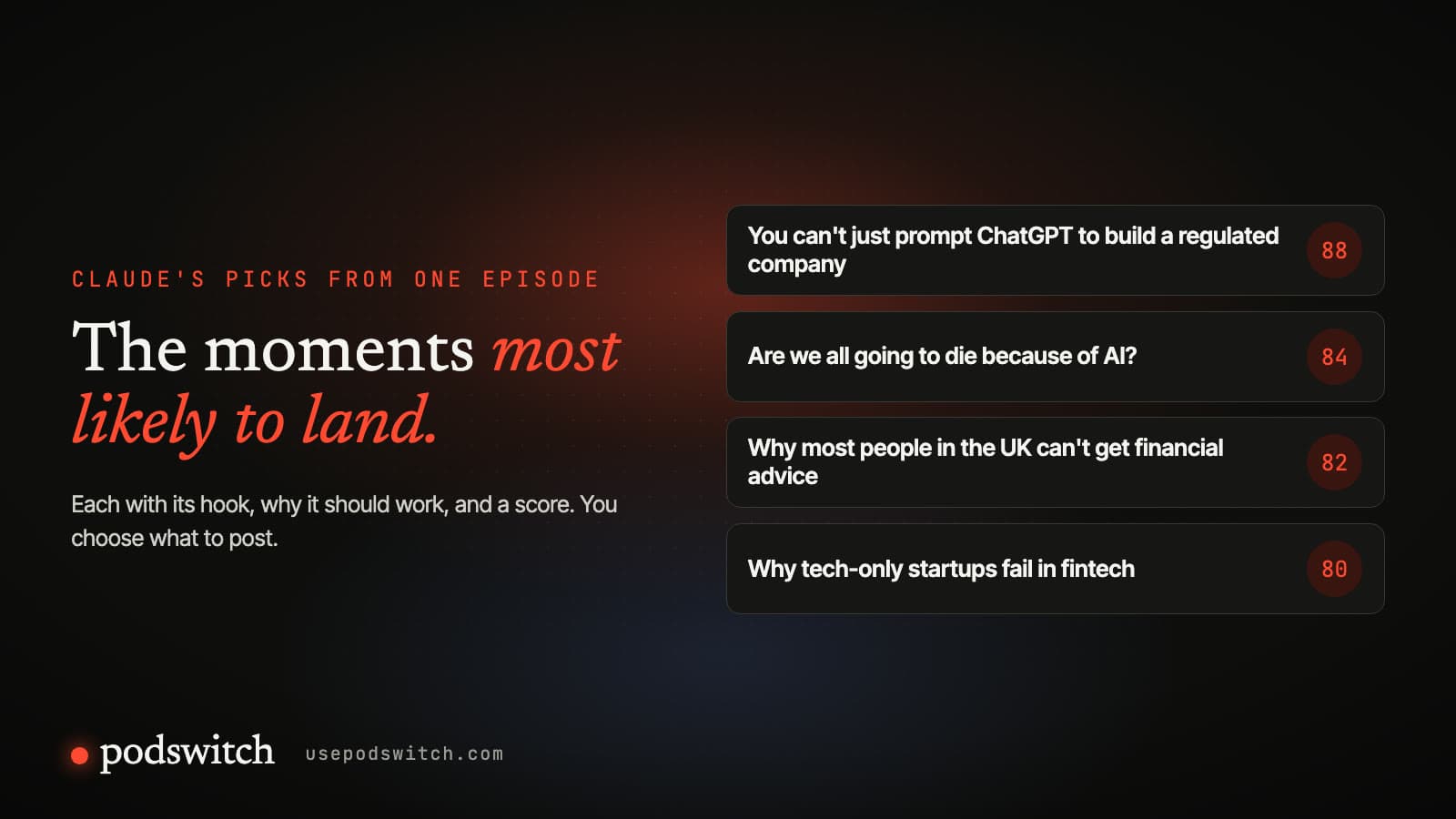
podswitch reads the transcript of your episode and suggests the moments with the best chance of working on their own, each with its hook, the reason it was picked and a score. The score is the AI model's judgement of how well a moment stands alone; it does not predict views. podswitch then builds every clip with the pauses cut, the camera on whoever is talking and captions timed to the words, so the parts of this checklist that are editing are already done when you open it.
Sources
-
TikTok Newsroom, "How TikTok recommends videos #ForYou", 18 June 2020. https://newsroom.tiktok.com/en-us/how-tiktok-recommends-videos-for-you ↩
-
Adam Mosseri, "Instagram Ranking Explained", Instagram, 31 May 2023. https://about.instagram.com/blog/announcements/instagram-ranking-explained ↩
-
YouTube Help, "Search and discovery tips for Shorts". https://support.google.com/youtube/answer/11914225 ↩
Common questions
Can a tool guarantee a viral clip?
No. How far a clip travels depends on the platform's recommendations, what else is posted that day and how viewers react. Anyone promising views is guessing. What you can control is whether each clip gives viewers a reason to watch to the end and share it.
Does follower count matter on TikTok?
TikTok says neither follower count nor whether an account has had high-performing videos before is a direct factor in its For You recommendations. Small accounts can reach new viewers if a video holds attention.
What is the most important thing in the first seconds?
A reason to keep watching. Start on the most interesting line of the moment, show the speaker's face, and put the words on screen as captions, so the hook works even with the sound off.
How often should I post podcast clips?
As often as you can keep the quality up. Posting regularly gives you more chances to learn what your audience responds to, but several weak clips do less than one strong one.