Guide
Royalty-free and AI music for podcasts and YouTube, and what the terms actually mean
By Lev PerlmanUpdated 7 min read
Royalty-free music means you do not pay a fee every time the music is played, but you still need a licence and still have to follow its terms. Copyright-free music is rarer than the name suggests: most music sold or shared as "free" is still owned by someone and comes with conditions. For podcast intros and background music, your safe options are YouTube's Audio Library, a music library whose licence covers podcasts and video, music licensed under Creative Commons, music written for you, or AI-generated music used under the tool's terms. This guide explains each one, and what UK law currently says about AI music.
This guide is general information, not legal advice. If a lot depends on it, ask a solicitor who works in music or media law.
What royalty-free and copyright-free actually mean
- Royalty-free: you pay once, or nothing, instead of a payment per play, per download or per view. The music is still under copyright. The licence decides where and how you can use it.
- Copyright-free: used loosely to mean "free to use". Strictly, it means music no longer protected, or never protected. In the UK, copyright in a musical work lasts 70 years after the author's death, and a sound recording is protected for 70 years from when it is first published.1 So an old song can still be protected, and a new recording of an old tune has its own copyright.
- Licence: the permission that sets the rules. Read it for where you can publish (podcast apps, YouTube, social media), whether you can make money from the content, whether you must credit the artist, and whether it covers ads.
Where to get podcast and YouTube music
YouTube's Audio Library
YouTube Studio includes a free library of music and sound effects. YouTube says these tracks are copyright-safe and are not claimed through Content ID.2
- Credit when asked. Some tracks use a Creative Commons licence, and YouTube says you must credit the artist in your video's description. You can filter for tracks where attribution is not required.2
- Outside YouTube. The page does not set out rules for using the tracks elsewhere, such as in your podcast feed. Check the licence shown for each track before you use it outside YouTube.2
- Other libraries. YouTube says it only knows its own Audio Library to be copyright-safe, and is not responsible for "royalty-free" music from other sources.2
Music libraries with a licence
Paid libraries sell a licence, often as a subscription. Before you pay, check that the licence names every place your episode goes: podcast apps, YouTube, short clips on social media, and any paid ads.
Creative Commons music
Creative Commons licences are standard licences an artist can choose. The building blocks are:3
- BY: you must credit the creator.
- SA: if you adapt the work, you share your version under the same licence.
- NC: non-commercial use only. A podcast with sponsors or ads is a commercial use to consider carefully.
- ND: you can share the work only unchanged.
Popular songs
Using a hit song, even briefly, needs permission from the people who own it. The UK's copyright exceptions are narrow, and the Intellectual Property Office's guidance on fair dealing asks whether the amount taken is "reasonable and appropriate" rather than giving a number of seconds.4 For an intro that plays on every episode, that is not a risk worth taking.
Podcast intro and background music: what to look for
- An intro you can own as a sound. The same few seconds on every episode becomes part of your show. Pick something with a licence that lets you use it for as long as the show runs.
- Background music that sits under speech. Simple, steady tracks with no vocals compete least with voices. Keep it quiet and dip it further when someone talks.
- The same rules for clips. Short clips cut from the episode carry the music with them, so the licence needs to cover social platforms too.
AI-generated music: is it copyrighted?
AI music tools can make a full track from a short description. Three questions matter: who owns it, whether anyone else can get the same thing, and whether it is marked as AI.
Who owns it in the UK
- The law today. Section 9(3) of the Copyright, Designs and Patents Act 1988 says that the author of a computer-generated work is the person who made the arrangements necessary to create it. Protection lasts 50 years.5
- It is little tested. Courts have rarely interpreted section 9(3), and how it fits with the usual test for originality is uncertain.5
- It may change. A UK government report published in March 2026 recommended removing section 9(3), while keeping protection for AI-assisted works where a person makes creative choices. No legislation has been introduced, so the law has not changed yet.6
What the tool's terms say
The terms of the tool matter as much as the law. Google's Gemini API Additional Terms, effective 23 March 2026, say Google "won't claim ownership" of the content you generate. They also say Google may generate the same or similar content for others.7 In practice, that means AI music is not exclusive to you.
Google's Generative AI Prohibited Use Policy does not allow misrepresenting where generated content came from by claiming a person made it alone, in order to deceive.8 So do not present AI music as a human composition.
Watermarks and platform rules
- Watermarks. Tracks from Google's Lyria music model carry a SynthID audio watermark, which listeners cannot hear.9
- Content ID still applies. YouTube scans uploads against files supplied by copyright owners. A match can lead to the video being blocked, monetised by the owner or tracked, depending on the owner's settings.10 Platform systems and rules apply whatever tool made your music, so keep a record of where each track came from.
Background music made for your conversation with podswitch
On the MAX plan, podswitch suggests background music based on what is actually said in your episode.
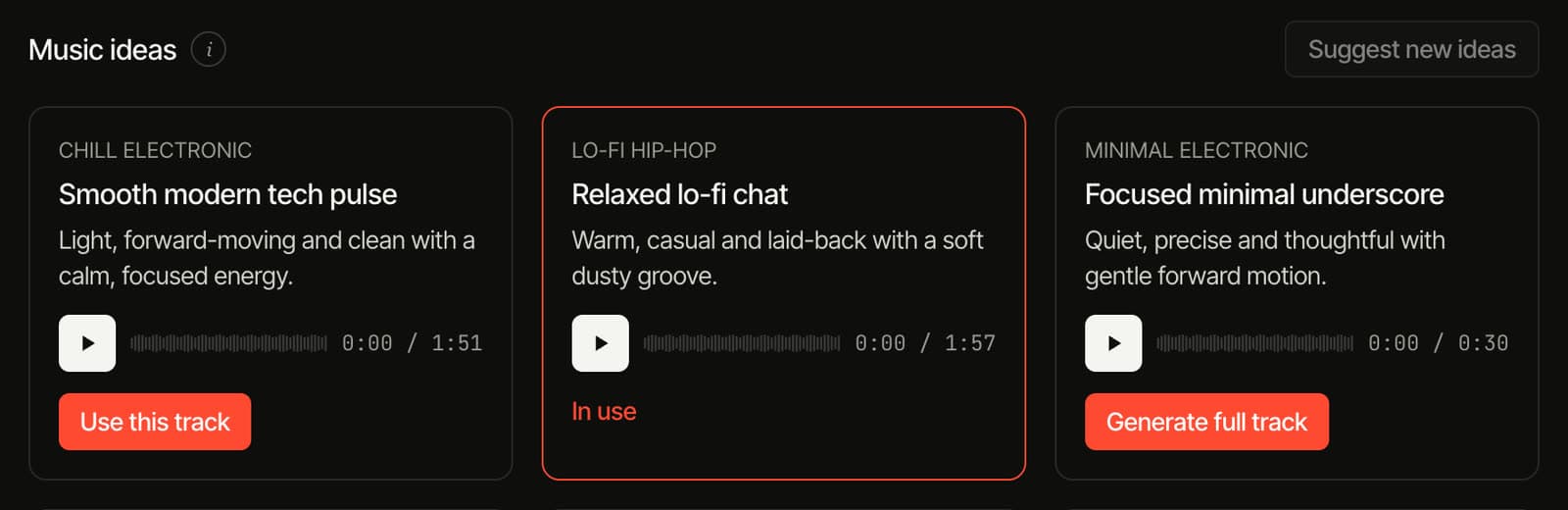
- Three ideas from the conversation, each with a mood and a 30-second sample to hear before you choose.
- A full track of the one you like, which plays quietly under the full edit and every clip and dips whenever someone speaks.
- On the timeline: move it, trim either end and set its level, or switch it off for any clip.
- Its own track in your Final Cut Pro, Premiere Pro or DaVinci Resolve files. Rendered MP4s include it too.
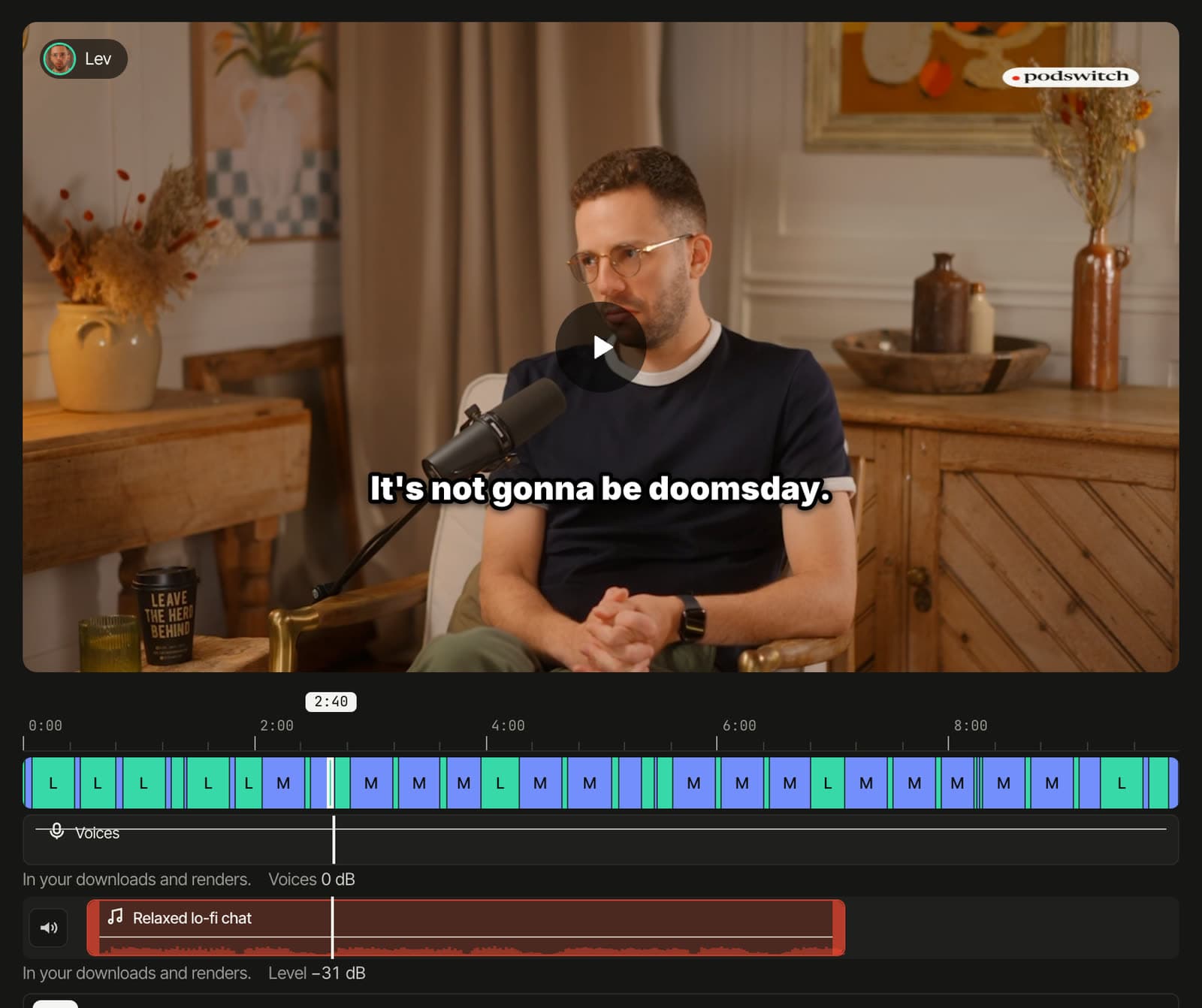
The music is made with AI, using Google's Lyria model through the paid Gemini API. Google receives only a short text description of the music, such as its genre, instruments, tempo and mood, with no audio, video or transcript.11 Nothing in Google's Gemini API terms asks for royalties on generated content.7 The tracks carry Google's SynthID watermark, and they are not exclusive to you: similar music may be made for others. Our sub-processors page lists every provider involved. See the Social Studio for the rest of what MAX adds.
Sources
-
GOV.UK, "How copyright protects your work: How long copyright lasts". https://www.gov.uk/copyright/how-long-copyright-lasts ↩
-
YouTube Help, "Use music and sound effects from the Audio Library". https://support.google.com/youtube/answer/3376882?hl=en-GB ↩ ↩2 ↩3 ↩4
-
Creative Commons, "Sharing Openly, Sharing Globally", section "The CC Licenses". https://creativecommons.org/share-your-work/cclicenses/ ↩
-
Intellectual Property Office, "Exceptions to copyright", GOV.UK. https://www.gov.uk/guidance/exceptions-to-copyright ↩
-
Authors Alliance, "The UK's Curious Case of Copyright for AI-Generated Works: What Section 9(3) Means Today", 19 May 2025. https://www.authorsalliance.org/2025/05/19/the-uks-curious-case-of-copyright-for-ai-generated-works-what-section-93-means-today/ ↩ ↩2
-
Bratby Law, "Copyright and AI: The Government Steps Back from a Training Exception", 23 March 2026, on the Report on Copyright and Artificial Intelligence published by DSIT, DCMS and the IPO on 18 March 2026. https://bratby.law/copyright-and-ai-training-exception-2026/ ↩
-
Google, "Gemini API Additional Terms of Service", effective 23 March 2026, section "Use of Generated Content". https://aistudio.google.com/docs/terms ↩ ↩2
-
Google, "Generative AI Prohibited Use Policy". https://policies.google.com/terms/generative-ai/use-policy ↩
-
PPC Land, "Google's Lyria 3.5 puts full-length AI songs in Gemini and the API", 6 September 2026. https://ppc.land/googles-lyria-3-5-puts-full-length-ai-songs-in-gemini-and-the-api/ ↩
-
YouTube Help, "How Content ID works". https://support.google.com/youtube/answer/2797370?hl=en-GB ↩
-
podswitch, Privacy notice, section on background music. ↩
Common questions
What does royalty-free music mean?
You do not pay a royalty each time the music is played or your video is watched. It does not mean the music is free of copyright, or free of charge. Someone still owns it, and you use it under a licence with terms you have to follow, such as where you can publish it and whether you must credit the artist.
Where can I get free music for YouTube videos?
YouTube's Audio Library in YouTube Studio. YouTube says its tracks are copyright-safe and are not claimed through Content ID. Some tracks use a Creative Commons licence and need the artist credited in your video description.
Is AI music copyrighted in the UK?
Possibly. Under section 9(3) of the Copyright, Designs and Patents Act 1988, a computer-generated work with no human author belongs to the person who made the arrangements for it, for 50 years. A UK government report in March 2026 recommended removing that protection, but no law has changed yet. This is not legal advice.
Is AI-generated music exclusive to me?
Not necessarily. Google's Gemini API terms say Google will not claim ownership of generated content, but that it may generate the same or similar content for others. Check the terms of whichever tool you use.
Can I use a few seconds of a popular song as my podcast intro?
Not safely without permission. UK copyright exceptions are narrow, and the Intellectual Property Office gives no fixed number of seconds that is allowed. Use music you have a licence for, or music made for you.